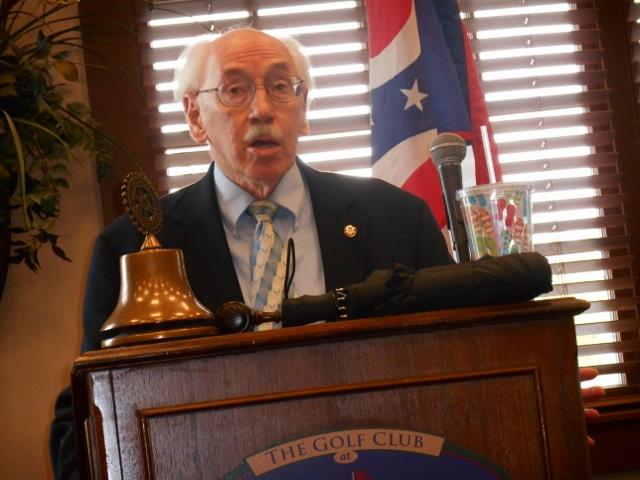
Member Ray Merz introduced our speaker, Squire Brown, who resides at Bethany Village in Centerville. He said Brown is a native Texan who earned his Ph.D. in aerospace engineering from the University of Texas in Austin. Brown retired as an aerospace engineer in federal service with the USAF at Wright-Patterson Air Force Base. His last position was Chief of Flight Mechanics for the Aeronautical Systems Center.
After retiring Brown joined the volunteer program of the National Museum of the United States Air Force here in Dayton, where he has assignments in the Research Division and is a docent for the Special Events Division, Merz said. In 2008 he was selected as Volunteer of the Year. He is the author of A Genesis Workshop: Five Generations of Engineering Enterprise from the Birthplace of Aviation, published by the Aeronautical Systems Center History Office.
Squire Brown said Congress designated the museum, formerly known just as the U.S. Airforce Museum, a national museum in 2004. National museums are physically large structures with lots of square footage, he said. They have quality artifacts, many of them rare and/or one of a kind. They have historical artifacts that show the development of our nation. He said there are ten (according to the official Web site) presidential aircraft in the newest addition to the museum. They are available to be seen only here and tell a story of our history. The museum is the keeper of the nation’s stories, he said.
The museum not only tells the story of our country’s military service, but also of America and the 20th century and progress and prosperity, and the advance of aviation technology.
The story of the Candy Bomber during the Berlin Airlift and other stories of war rescues, the WACS, combat pilots, etc., are told in the museum.
Brown said the first building was erected in 1971. It showed America’s role in human affairs. The second building was opened in 1988 and the third building was opened in 2003. With the third building the galleries were reconfigured and more than 200 of the planes were moved, with only the B-52 Bomber and the B-124 large aircraft remaining in their original places.
To move the B-36 Bomber to the third building, a wall had to be taken out of the north end of the first building because of the plane's great wing span. It was the central element of the Cold War, Brown said.
The galleries were renamed. The Early Years had the first military planes, with the Wright Flyer to WWII.
The second building, which has proven to be the most popular, is the Airpower gallery wiith the Korean and Southeast Asia war periods, he said.
The third building is the Cold War Gallery with missiles and supporting planes.
The hallway that leads to the fourth building, the newest one, takes one to four galleries.
Brown said the new building will be open to the public June 8.
The museum will also have Learning Nodes, with three STEM educational programs with demonstrations, presentations and videos.
On June11-12 there will be special displays and hands-on educational programs, Brown said.
Eugene and Virginia Kettering were instrumental in helping get the museum funding started. Revenue comes through the Air Force Museum Foundation through donations, grants, concessions, annual subscriiption fees, the Imax theater, individuals and organizations, etc., Brown said.
Once a building is completed, the museum foundation turns it over to the U.S. Air Force, and it belongs to the Air Force Materiel Command, Brown said.
Some 500 volunteers help keep the museum operating, Brown said. They have oversight of the galleries. More volunteers are needed, he said. The fourth building has a staff of 20 volunteers to work three shifts seven days a week. You can go to the museum’s Web site to find out more about volunteering, he said.
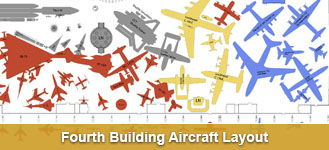
More information and pictures of the planes and floor layouts can be found on the museums Web site by calling up the National Museum of the U.S. Air Force. Also details and times for the various events are shown in detail there. The following detailed information is just a small part of what can be found on the Web site, which shows exactly where and when things will happen, such as book signings by authors of aviation books. The June 11-12 special activities are also detailed. The Web site states:
National Museum of the U.S. Air Force visitors are invited to be a part of history during a ceremonial ribbon cutting event that will officially open the museum’s fourth building to the public on June 8 at 9:15 a.m.
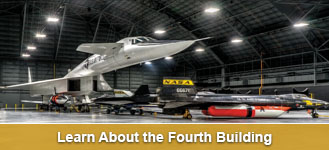
The new $40.8 million, 224,000 square foot fourth building, which was privately financed by the Air Force Museum Foundation, will house four galleries – Presidential, Research and Development, Space and Global Reach, along with three science, technology, engineering and mathematics (STEM) Learning Nodes.
Among the stories found in the fourth building will be the VC-137C Air Force One (SAM 26000), which was used by eight presidents - Kennedy, Johnson, Nixon, Ford, Carter, Reagan, George H.W. Bush and Clinton; the only remaining XB-70 Valkyrie; the C-141C
Hanoi Taxi, which airlifted the first American prisoners of war out of North Vietnam in February 1973; and the massive 96-ton Titan IVB space launch vehicle.
Doors will open at 8:30 a.m. and the first 100 individuals (at least 16 years of age) will receive a $10 Air Force Museum Foundation gift card upon entering the museum. Gift cards can be used at the museum store, theatre or simulators, and will be valid for a period of five years.
National Museum of the U.S. Air Force Director Lt. Gen. (Ret.) Jack Hudson and Air Force Museum Foundation, Inc. Chairman, Board of Trustees, Philip L. Soucy will cut the ribbon to open the gallery along with two lucky young visitors who will be selected on the day of the event.
Once the ribbon has been cut, visitors will be able to see more than 70 aerospace vehicles including 10 presidential aircraft and a world-class collection of flight test aircraft, along with exciting space artifacts and huge cargo planes. Visitors can climb aboard the Space Shuttle Exhibit, walk through four presidential and three cargo aircraft, or try out the Air Force Museum Foundation’s new suite of simulator rides, including the Pulseworks’ Virtual Reality Transporter, the first of its kind in North America, featuring an exclusive Space Voyage experience.
Although the building will open to the public on June 8, special weekend activities for all ages will take place June 11-12, including educational demonstrations; special costumed characters like Stormtroopers and aliens; various performances by the U.S. Air Force Band of Flight; and interactive displays. In addition, the Air Force Research Laboratory will offer several interactive experiences including one that teaches programming within a Minecraft-type environment, and an Aeromedical Evacuation crew and a Critical Care Air Transport Team (CCATT) will simulate how they provide combat casualty care on a global scale.
Outside the museum that weekend, visitors can check out the Vapor Special Ops Supercar. A team of highly-specialized Airmen partnered with car mechanics and customizers from Galpin Auto Sports to create a fully customized Dodge Challenger showcasing stealth technology. A trailer near the car gives visitors the chance to engage in interactive experiences, such as the touch-screen game “Airman Challenge.”
The National Museum of the U.S. Air Force, located at Wright-Patterson Air Force Base near Dayton, Ohio, is the world’s largest military aviation museum. With free admission and parking, the museum features more than 360 aerospace vehicles and missiles and thousands of artifacts amid more than 19 acres of indoor exhibit space. Each year about one million visitors from around the world come to the museum. For more information, visit
www.nationalmuseum.af.mil.
The Air Force Museum Foundation, Inc. was established in 1960 as a philanthropic, non-profit organization to assist the Air Force in the development and expansion of the facilities of the National Museum of the United States Air Force, and to undertake and advance programs and activities supporting the museum. The Foundation raises funds through its membership program, the Air Force Museum Theatre, Museum Store, flight simulators and Valkyrie and Refueling Cafés, as well as from direct donations. For more information about the foundation, visit
www.afmuseum.com.
NOTE TO PUBLIC: For more information, please contact the National Museum of the U.S. Air Force at (937) 255-3286.