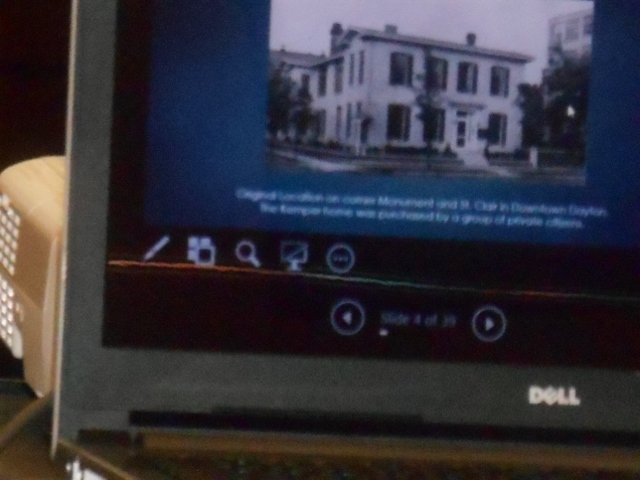
Below is the original Dayton Art Institute building, a mansion on Monument Ave. in Dayton
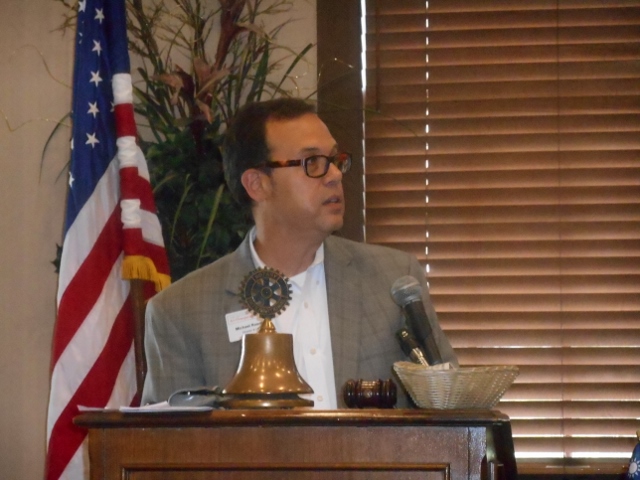
Our speaker said he has been with the Dayton Art Institute since 2011. He was with the Victoria Theater for 14 years before that. He earned a master of science degree from Wright State University and a Bachelor of Arts degree from Ohio University. He is a member of the Dayton Rotary and lives in Kettering. He has a son, Richard, he said.
He began by giving a history of the Dayton Art Institute, noting that it started as The Dayton Museum of Arts, which included a school of art, in 1919. The original building was torn down when a new museum took its place. Below is a picture of the dedication of the new museum in 1928.
The museum owes its existence to a host of prominent Daytonians, foremost of which was Julia Shaw Patterson Carnell, Michael said. Orville Wright and the Patterson brothers also were patrons of the project. Julia married Frank Jefferson Patterson, brother of John Patterson, who founded NCR, but Frank Patterson died young (1849-1901). Julia inherited her wealth from him and in 1909 married Harry Gardner Carnell, comptroller at NCR then. She was the mother of three children, one being Jefferson Patterson, also of note in the history of the museum, Michael said.
Julia was a socialite, a philanthropist and a preservationist, he said. She helped save the Patterson Homestead. She established Dayton’s cultural community. She was a co-founder of the Dayton Foundation. She was a co-founder of the Dayton Women’s Club. She was a major contributor to Miami Valley Hospital, and she was a benefactor of the Dayton Art Institute, he said.
Michael said the first registered piece of sculpture in the institute’s collection, Joy of the Waters, a bronze statue, is still at the museum, but instead of being outside, it is in the American Impressionist Gallery.
He showed a picture of a life drawing class, done with a fully dressed woman, not a nude, as one pictures most such classes today.
He said Mrs. Carnell (1863-1944) traveled all over the world, but especially liked Italy and Italian architecture. She picked Edward Green, a prominent museum architect from Buffalo, N.Y., to design the building. Completed in 1930, it was modeled after the Villa d’Este near Rome and the Villa Farnese at Caprarola in Italy, both examples of sixteenth century Italian Renaissance architecture, he said. Today, The Dayton Art Institute's architecturally and historically significant facility is listed on the National Register of Historic Places, according to the facility's Web site.
Michael showed a picture of the building in progress, with three arches and water coming down from a fountain. He said they hope to get the fountain running again and to prepare the building for the 2019 centennial celebration. A time capsule was put in with the laying of the cornerstone in 1928, he said.
The 1926 RollsRoyce Silver Ghost Arundel Limosine, owned by Mrs. Carnell, is apparently still around, according to an Internet site that said she drove it to the dedication of the DAI in 1928.
Michael said the museum has received a gift of $500,000 from a donor to help prepare the building's brickwork for the centennial. Back when it was built it was a respite from real life for many, he said, as there was no TV or major entertainment around.
…It has been called Dayton’s Living Room, Michael said. He showed a picture of Mrs. Carnell with Orville Wright and the Colonel and Mrs. Deeds, all of whom were involved as patrons in the building of the museum. Names like Elsie Mead and Virginia Kettering were also part of the history. It is said that Mrs. Carnell had told the builders: No cloisters, no building. She wanted cloisters and got them, he said.
At one time there were animals kept at the museum to attract people to it. There were white peacocks, llamas, sheep, miniature Indian donkeys, Coke and Cola, and cages with birds and monkeys, he said. ..”but they throw things that aren’t good for us,” he said.
The Italian cloister was restored in 2012 with the help of Denise and Rip Hale. It was re-dedicated on Mother’s Day. Michael also showed a picture of the Shaw Gothic Cloister as it looks today.
Julia’s son Jefferson Patterson, a dignitary and diplomat, was responsible for building the Pre-Columbian Collection in the museum, Michael said.
Virginia Rike Haswell, Virginia Kettering, and James F. Dicke II also had special roles in the development of the museum’s collections. Virginia Rike Haswell was responsible for getting the famous Hopper High Noon painting, and Virginia Kettering, who traveled extensively in Asia, helped build the Asian Collection in the 1950s. She and Julia would bring things back from Asia, Michael said.
Jim Dicke, who owns Crown Equipment Corp., helped keep the museum open in 2008, during the recession, and is an emeritus chair trustee on the museum board, he said.
The museum collection is encyclopedic, he said. It covers all areas and 5,000 years. The African and pre-Columbian collections are considered among the finest in the country, he said. The Oceanic collection is rare for us to have, he said. It is one of the largest such collections. The Asian collection was once ranked fiftth in the nation, During the 2019 centennial, the Sir Joshua Reynolds painting the DAI has of Henry, 8th Lord Arundell of Wardour, in its Berry Wing of European Art, will visit Dallas, Tx., where a painting of Lord Arundell's wife has been for many years. Then the wife will come to Dayton for the exhibit here, Michael said.
Michael said the Waterlilies painting by Claude Monet is among Monet’s top 15 works. It resides in the DAI, but is often borrowed by other museums. In the ‘50s the man who owned it was asked if he would give it to the DAI. “It came in a crate, unannounced,” and the owner never came to see it here, he said.
When the museum opened it had 200 objects. It now has 27,000 objects, Michael said. One to three percent are out on view at any one time, he said. The Yeck family left an endowment, and that is one way area residents can help ensure that the museum will continue to be an art treasure for this area, Michael said. Many have left a legacy by including the DAI in their estate planning, he said. The Carnell Circle, established in 1995 with 21 charter members, now has a membership of 144, representing known gifts of more than $12.8 million dollars. Bequests are the most common planned gift, according to the DAI’s planned giving guide. The bequest is made through your will and pays out to the museum upon your death.
The Rike building next to the museum was built in 1964, Michael said. Ten years later it closed. It is used for educational classrooms and administration offices now, he said.
Mrs. Carnell died in 1944, so she did not get to know about the Contemporary Gallery in the museum, built after that time. The goal is to build the best collections and financial strength through endowments, Michael said. The Oktoberfest brings in over a half million dollars every year and the Art Ball, now in its 87th year, adds to that.
While the original DAI building, a mansion located on Monument Avenue in downtown Dayton no longer exists, Julia’s generous offer to build a new museum if the community would endow it and pay for its operations, was accepted, and she gave $2 million to get it started.