Rotary's Theme for 2016-17
The GREETERS:
01/12/2017 Dan Johnson and Brandon Gross
01/19/2017 Kim Senft-Paras and Jack Durnbaugh
01/26/2017 Dan Johnson and Bridge Herzog
02/02/2017 Mark Febus and Sara McGarvey
If you cannot greet on the day assigned, contact Kitty and she will schedule a replacement.
12/08/2016
The greeters at the next meeting will be Dan Johnson and Brandon Gross
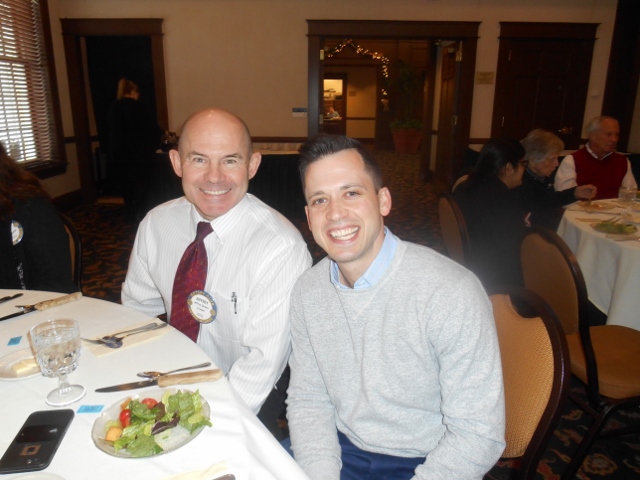
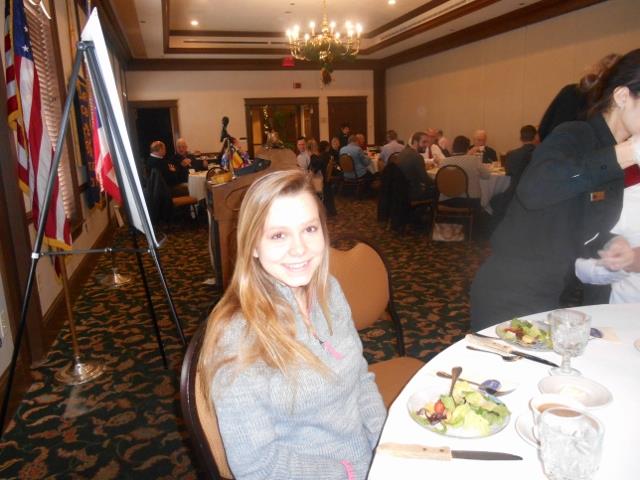
The guests at the meeting included: Tim Wilson, a prospective member and guest of Jeff Senney; Emily Biondo, the daughter of member Arnie Biondo; Al Scott, of the Miamisburg Rotary Club; and Saloni Bagwani, our super smart exchange student from India.
Tim is with M & M Title Company, and is seen here to the right of Jeff Senney.
.
Emily Biondo is seen waiting before the start of the meeting
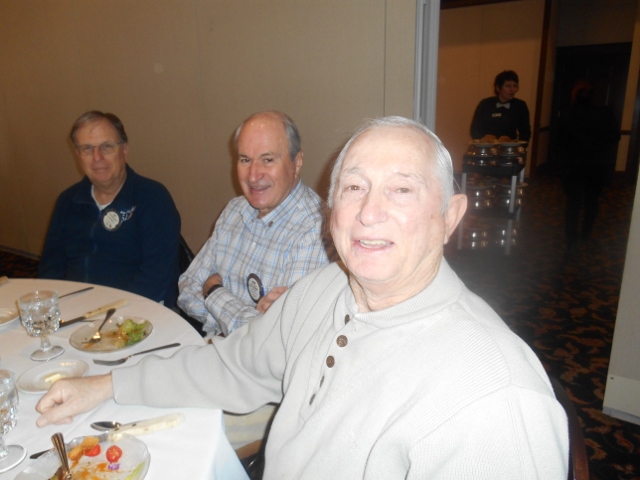
Centerville Rotarians Lee Hieronymus and John Beals make room for Al Scott at their table.
This happy group includes PDG Harvey Smith with Saloni and her host family members,
Emily and her dad Arnie Biondi.
The Centerville Rotary Club met at noon at the Clubhouse at Yankee Trace Golf Course. President Ron Hollenbeck led the Pledge of Allegiance, Ray Merz gave the prayer, and Drew Carter led the singing of God Bless America.
ANNOUNCEMENTS:
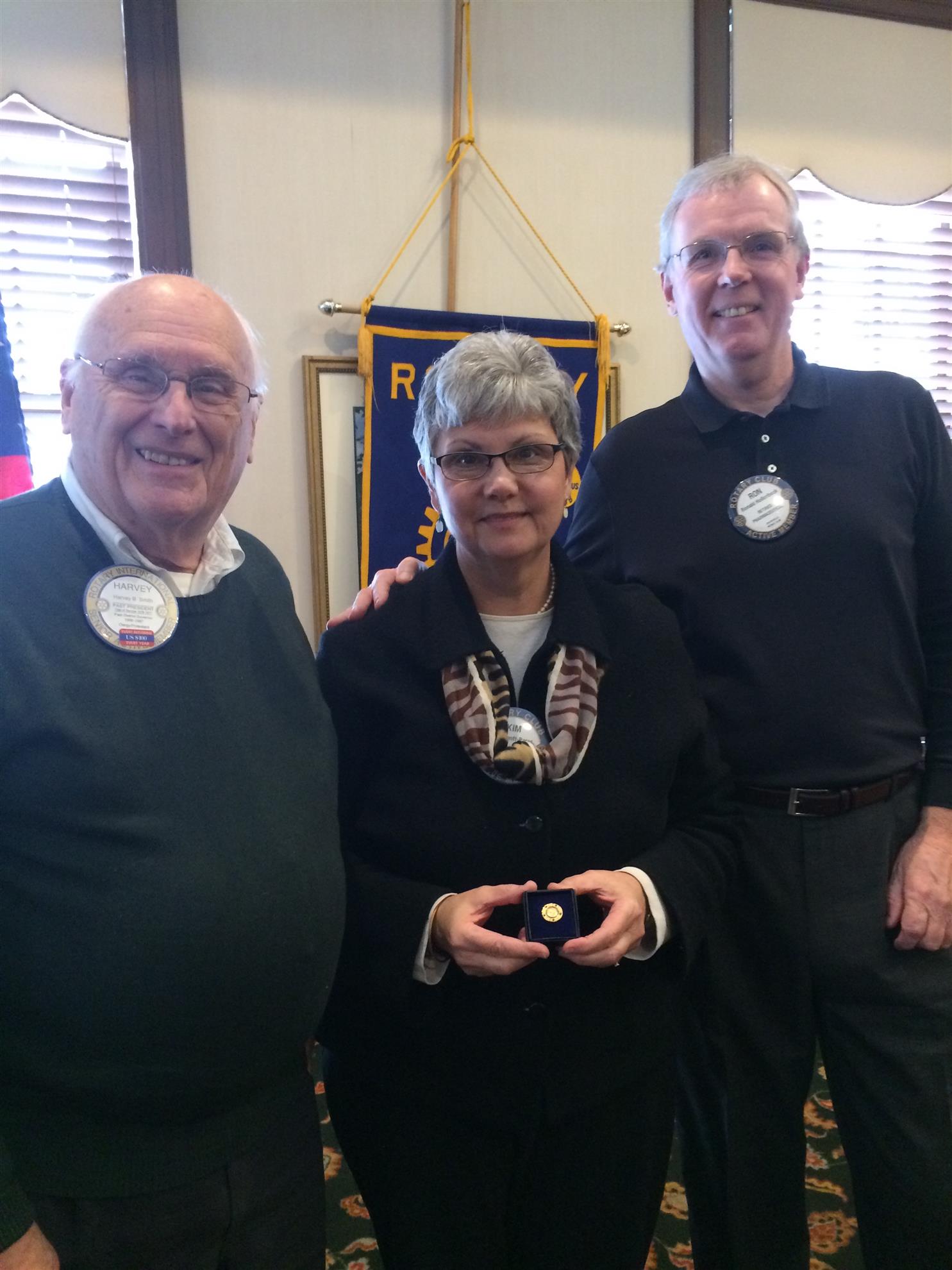
President Ron Hollenbeck began the meeting by calling member Kim Senft-Paras, our Youth Services Director, to the podium to receive her Paul Harris Fellow pin, signifying the fifth donation she has given to the Rotary Foundation. She was unable to attend the December Christmas dinner at which time the others donating received their pins of recognition.
Ron noted that members wishing to attend the Martin Luther King, Jr. breakfast Jan. 16 at Yankee Trace need to let him know as soon as possible.
He said more information on the District Conference to be held this year at the Marriott will be forthcoming, and noted that grant requests for club projects will need to be submitted in advance this year.
HAPPY BUCKS: Brian Hayes stood in as Sgt.-at-Arms for Erich Eggers, and is seen in the picture below sporting glasses loaned to him by our club treasurer Gerry Eastabrooks, standing nearby. He has just shouted out someone's name, which is probably why Gerry has "that" look on her face...
Brian collected the Happy Bucks for Homefull, a charity we have helped in the past. It is a 24-hour gateway that helps homeless men, he said. It helps them find and keep jobs and homes.
Brian started off the donations by giving $5 himself. Then came several more $5 donations, including one from Jim Hester and one from our guest Al Scott. John Beals gave, noting that he and his wife Sally were at Jackson Hole with family over the holidays, a high altitude place with beautiful mountain top scenery.
Lee Hieronymus, Mark Febus, and Harvey Smith contributed, Harvey mentioning having been three weeks in Florida with 85 degrees on Christmas Day and eight hours of having to do next to nothing...then came Mike Wier, taking off to Florida for the winter now, a couple of days late, seeing that it is snowing today and will be 8 degrees tomorrow.
Frank Perez gave for a Happy New Year and Kim Senft-Paras and Joyce Young gave for the New Year
Then Jeff Senney mentioned going to Washington D.C. to attend the Trump inauguration, and said something about tax work. Ann Blackburn gave for a Happy New Year, and Peachy gave for the Browns winning a game finally and getting a first draft pick, and for a first ultrasound for a new granddaughter. Ron Hollenbeck also gave for the Browns.
Carol Kennard noted that if you want to get seats for the MLK, Jr. breakfast, that there are only 10 seats left. She said the speaker will be Barbara Cross, a survivor of the 16
th Street Baptist Church Bombing in Birmingham, Alabama in 1963. The program is presented by the Centerville-Washington Diversity Council, which gave the following information about the upcoming program:
The 17th annual CWDC Breakfast will begin at 7:30 a.m. Tickets are $20 each with a table of ten for $200.
Described by Dr. King as “one of the most vicious and tragic crimes ever perpetrated against humanity,” the bombing killed four little girls attending Sunday school and injured 22 others.
At the time, Birmingham was a tense, violent and racially segregated city. Ms. Cross’s father, Rev. John Cross, was pastor of the church that had become a rallying point for civil rights activities.
On the morning of September 15, four members of the United Klans of America planted 15 sticks of dynamite under the steps of the church. The explosion killed four girls: Addie Mae Collins, 14; Carol Denise McNair, 11; Carole Robertson, 14; and Cynthia Wesley, 14.
Ms. Cross, 13 years old at the time, had attended the same Sunday School class as the four girls on the day of the bombing. The theme of the class that day was how to react to physical injustice.
She testified as a prosecution witness in the 2002 trial of Bobby Frank Cherry and said that she would have accompanied her friends into the basement lounge to change into choir robes for the sermon, but said she had been given an assignment. She was struck on the head by debris and was injured by the explosion.
She and her father, who testified in trials against the members of the Klu Klux Klan, later received commemorative pins from the FBI in recognition of the role they played in the prosecution.
The bombing introduced a new level of infamy to Birmingham and changed the course of Ms. Cross’s life. Already on edge from the ongoing racial tension, the city drew attention from around the globe. She has shared her historical perspective and survivor experience with audiences nationwide.
Worldwide awareness and sympathy towards the civil rights cause increased after the bombing of the 16th Street Baptist Church, the Freedom Riders, the March on Washington and the assassination of President John F. Kennedy, who proposed the Civil Rights Act of 1963.
The mission of the CWDC is to celebrate and promote an inclusive, diverse and welcoming community for people who live, work, and worship in Centerville and Washington Township. The council is comprised of nearly 60 representatives from community organizations as well as a cross-section of various races, ages, sexual orientations and physical abilities.
xxxxxxx
Continuing with our Happy Bucks:
Rebecca Quinnones gave a sad dollar for the loss of her grandfather and Mitch Biederman gave $20 for missed and future missed meetings, as he will have to attend teachers meetings throughout the year that occur on Thursdays.
Jim Harris gave for Homefull and Dick gave a sad flimsy dollar for the sad OSU showing against Clemson on New Year's Eve in Arizona. He still proudly wore what looked like a new OSU red sweater. And Greg Horn gave a number of dollars, the last being for his retirement from being the city manager for Centerville in July. When asked about his retirement plans, he said he plans to do nothing for a while, and left it at that.
Arnie Biondo reminded everyone that the flurries we were seeing this day, "is not snow." Coming from the Chicago area, he said he knows snow when he sees it, and this isn't it...Then again, we do get some Chicago like winds and snow that blows our way, but hopefully not soon.
Today's Speaker: Steve Neely, Springfield Rotarian, speaking about his club's many projects in Lesotho, South Africa, over the past seven years. He has invited club members to go along on one of their visits this year and/or to participate in helping fund their projects as we have in the past.
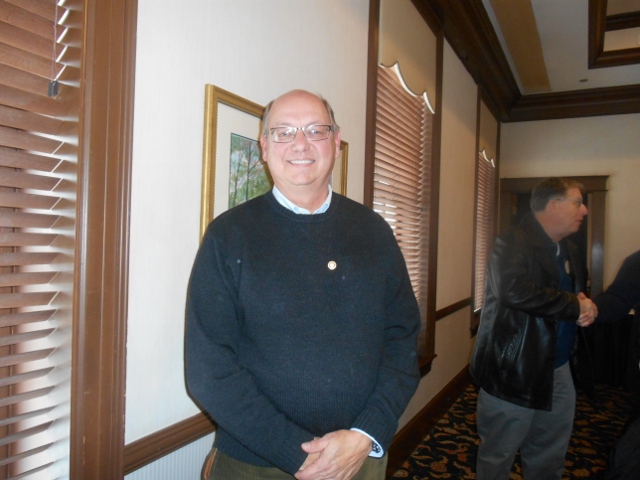
Peachy Metzner filled in for Boyd Preston to introduce our speaker. He said Steve informed him that he and his wife settled in Springfield after graduating from Wittenberg in 1975. They raised three children, two of which have moved back to Springfield to live. He said he spent five years teaching and as Wittenberg's swimming coach. He then spent 20 years in the medical distribution business, becoming Vice President of Alternate Site Sales for McKesson Corp., with 450 straight commission sales reps across the country. In 2001 he purchased Armoloy of Ohio, a specialty coating company in Springfield.
Steve has been a Rotarian for 17 years, holding a variety of offices, including President in 2011-2012.
Steve started his presentation, complete with visuals, by telling us Lesotho is a small country in the middle of South Africa. It starts at 7,000 feet and goes up, he said. It is also one of the poorest countries in the world, with most of the people living in the mountains.
The Springfield Rotary Club's connection with Lesotho began eight and a half years ago with a Wittenberg professor going there with the Peace Corps, he said. That professor began taking 35 students for six weeks each year to try to improve the blight of the many orphans there. The orphans wear uniforms seven days a week, all day long...usually the same one, he said. There are 142 orphans in the orphanage he showed pictures of. He said it had no insulation and last summer the days were 110 to 115 degrees every single day. In the winter the temperature is 60 to 65 degrees, he said.
They have no central heat and no air conditioning, he said. They use coal stove and blankets to keep warm. Some of the orphans slept on bunks and 22 slept on the floor. Each child had a locker and they took sponge baths using basins.
Steve said when Hans Berkel, our past member, was still alive, he helped and the club got a matching $225,000 grant to work with a Catholic orphanage there. They built a new orphanage of brick five years ago. There were 65 children in a classroom with a leaking ceiling, so their club gave money to put on a roof. They were able to add greenhouses, pig sties, and a swing set. At the ribbon cutting 600 people from the local community came, he said. They thought they would do just a three-year project, but after seven years they are still going, he said. Now they are not spending money but working with them to oversee what is going on, such as the solar panels that the water is heated by.
Last April the children built a rock garden in honor of the work done by the Rotarians, he said.
Because of El Nino, this is the second year of a three year drought there, Steve said. Crops do not grow where there is no water. They drilled a new bore hole to keep gardens going and are trying different types of gardening, such as a keyhole walk-in style that keeps the cows out but lets the people in, and shade gardens that have need for less watering than open fields. The residents are raising chickens and selling them and a local insurance company is building a slaughter house for their use.
He said among other projects, they brought a man to the U.S. to be treated for a brain tumor and have also set up two school libraries (with some help from us too, he said), and one community library.
At another orphanage they have children and two homes or the elderly, and chickens and a bakery selling 600 loaves of bread a day. A small subdivision of 10-by-20 two-room homes, with a living room and bedroom, is being developed. There is a six-year payment plan so residents can pay a small stipend to live there and feel true ownership and take care of the area. People are digging footers for another group of 42 small homes. They need footers two deep and two shallow, and a nun overseeing the project who seems like a Mother Theresa, Steve said, goes along and checks all the work, making sure they dig deep enough.
This note from June 10, 2013, on a Springfield Web site, tells more about the beginnings and our own late Hans Berkel's help as District Governor at the time, as adapted from the Springfield Sun-Times:
Since 2008, the Springfield, Ohio, Rotary Club has propelled local pledges of $60,000 into $224,000 for helping AIDS-infected orphans in Lesotho, Africa, pursue a better life. Rotarian members thought the club should live up to its name, "Rotary International," and get involved in a global project. The group searched for ideas and learned of Wittenberg University Professor Scott Rosenberg's annual trips with students to Lesotho. The group discovered that Lesotho had extensive poverty problems and high numbers of AIDS orphans. Rosenberg, a club advisor, now claims that the international project is "on a scale I could only dream about."
With support from the late Hans Berkle, Rotary District 6670's then-governor, the Springfield club's efforts magnified. At a breakfast, Berkle initially promised $15,000 in matching funds, then $25,000, and eventually $75,000 in district funds, leading the Springfield club to obtain Rotary Foundation grants. Their first effort proposed a 56-child dormitory in an established orphanage in Motsekuoa village, where they replaced outhouses with showers and modern bathrooms. They also renovated an existing dormitory that housed 142 children. The orphanage project expanded to meet the spiraling number of HIV crisis orphans. The orphanage combined HIV and non-HIV orphans, reducing the stigma accompanying HIV isolation. The project added a health clinic.
The Rotary project has spawned other collaborations. Rotary International and the Maseru Rotary Club in Lesotho's capital city created Kick4Life, an AIDS awareness program built around soccer, as well as a hospitality training project in which the orphans learned the business by working at bed-and-breakfasts. The project developed a successful relationship with Sister Gisele, a Canadian nun, who operated a girls' school and a homeless and seniors housing program in Maseru. Ohio's Clark County teens have joined Interact Club, Rotary's club for high school students, for which they collected and packed clothing and books for shipping to remote mountain villages in Lesotho. Interact Club also helped Maseru High School students form their own Interact Club, a club that is now raising pigs, rabbits, and chickens to feed the orphans. The Interact Club held a fundraiser that paid for orphans' blankets at a Motsekuoa school. More projects are in the works.
The Springfield Rotary has an Orphan Head-of-Household program now that states for $37 a month you can help sustain a family for one month. They are looking for clubs to help support such programs.
Commenting on Springfield's Interact Club, Rosenberg noted the benefits for the city's next generation's involvement in helping others, and declared, "You never know how this kind of exposure at 17, 18, changes your life."
Steve Neely also gave examples of helping a disabled man and several other Lesotho residents who have come to Springfield to further their education.
The club ended the meeting by reciting the words on Rotary's Four-Way Test:
.jpg)